Monday, October 12, 2009

It's fall now...


And it's a time to take a deep breath; first one in the past six months or so when this crazy whirlwind called summer started.

I've done a lot. It's been fun and hard. Lots of gardening, and building and working for money and bits of this and that.

The trailer house has come along very well. We're not quite done yet, but we live in it anyway. It's dry in there and warm and some things have a place to go while others are piled in as unobtrusive a fashion as possible. There's no sink or water inside, but a hose and a shallow pit do the trick for now. The woodstove got fired up the other day, and it has been drying our clothes and our mushrooms. The shed roof on the north windowless wall is keeping the firewood and the tools and the freezer dry. By winter there may be a fully functioning kitchen. The insulation of the floor might wait till next year.

The garden was great. We had the first season in our new plot of dirt a short 25 minute bike ride away. The soil there never dries out completely, despite serious drought. And things grow like gangbusters without much effort by way of fertilizing... all in all it's the lazy man's garden and boy did we ever get away with some garden neglect. it was great. and we have lots of food to eat all winter. We kept it pretty simple out there, just the basics.

I've been doing a bit of salmon fishing lately. It's fun.. but a lot of work. Caught a few pinks.. no cohos.. I'll keep trying. been casting from shore on the campbell river.

Hoping to do some deer hunting and goose hunting this fall.

Moved from the ol' farm there down to where we've got these goats with a few other folks. That's been fun and challenging. the goats are great, our new lord and lady are great, the location is great.

the goats take a lot of work. we have to walk them a couple of hours everyday that we milk, which is twice a week usually. And then there's the milking on top of that. all in all it's about 3 hours be gallon. not the greatest return.. so there are some doubts that this is an efficient way to get food. We'll see what kind of a hunter I am.

I've been on the board of the friends of Cortes Island for a year now, without really doing much.. but it has been interesting to see the comings and goings of a tiny commmunity NGO.

Did a bit of carpenter's helper work for a while. We saved the community hall from collapsing due to water and ant infestations. And we built the first in a series of composting toilets at the venerable Channel Rock.

That's the main drag of my life in the last half year since I've last written. I'll do some e-thinking this winter and come up with some real deep shit, instead of just journaling, which is kinda lame.

check this out: goingferal.wordpress.com

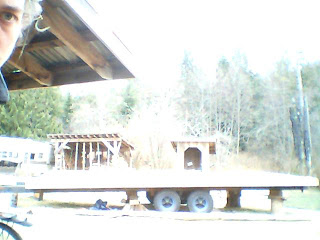
oh. and I got this truck. It's awesome.

L!fe is good.

Monday, April 27, 2009

Foodie food.


There are some hot new trends in the foodie world. Local, wild, heritage this and that, traditional, full fat, organic, sustainable, fair trade are all the buzz amongst those interested in food and a lighter way to live on the planet. Almost all my meals are glorious expressions of these new trends. I feel inspired to share some of the more exciting examples of this way of eating and obtaining food. So, this is the first installment of my new foodie series.

This morning, on the menu was, poached eggs on toast, with roasted and refried root vegetables.

The eggs (organic, free range [they go right outside and run around], from the farm I live on), were poached to perfection in water heated by the wood stove that also heats my home. The vinegar in the water to keep the eggs from being diluted into the cooking water was pressed from surplus apples picked last fall on this island and fermented by a friend of mine.

The bread for the toast was baked by my lover, Kate. A traditional German whole grain rye, called Volkenbrot. It is a sourdough bread with sunflower seeds, whole rye kernels, rye flour, wheat flour, pumpkin seeds and sesame seeds. This was toasted on the surface of the wood stove.

On this toast was wild cultured butter from the cream of the milk of the cows I milk on the farm I live on. On top of this was a cheese made by straining the whey out of yogourt made from milk from the same cows. Then the pesto went on. This came from the freezer, made last year of the basil grown on this farm, garlic from the island, sunflower seeds from i-don't-know-where, sea salt.

On top of this pile went the eggs and topped with salt that I made on the woodstove from water from the sea and pepper that I got from the freestore. And a sprinkle of raw spring garlic shoots, chopped, and a blob of steamed nettles that were dried from last year completed this part of the dish.

At the side of this creation was a little pile of potatoes, parsnips, onions, squash, garlic greens all grown by myself and others on this land that I live on. They were roasted the night before in cow fat rendered from a cow killed on the farm, and then refried.

I was researching the eating of garlic greens when I cam across a foodie blog about just that. And I thought, pshaa!, I can beat that. And this wasn't even an effort. These are just the natural combination of the fabulous ingredients that I have surrounded myself with. It's easy. ... Hot shit.

Sally Fallon, eat your heart out. (??What an expression??)

L!fe is good.

Sunday, April 12, 2009

Freedom is a free-store.

Cortes Island, where i currently live, is one of the few communities on this planet that is fortunate or enlightened enough to have a free-store.

A free-store is a like a thrift shop, run by volunteers, where nothing costs anything and everything costs nothing. It's all free. And this is a great, great thing.

You can get almost anything you need from the free store. I've gotten cast iron cookware, animal furs and skins, shirts, jackets, belts, rubber boots, books, shorts, socks, CDs (including Dance Mix 95, oh yeah!), movies, backpacks, fanny packs, beer (in the form of coopers beer kits), spices, blankets, and some other stuff I can't remmeber.

The free-store allows us to cycle the things we no longer need around our community. One need never buy another article of clothing so long as we have a free store. We can fulfill our modern need to shop and consume without destroying our beloved planet in the process.

We can clothe our children who outgrow things before they wear them out without spending a dime. We can get them new toys and bring them back once they're boring. We can get all manner of fix-it projects or materials for our next great invention.

If you are lucky enough to have your own free-store, or if you visit ours.. here's a couple of tips:

1. If you aren't sure, take it. try it for a week or two. if it doesn't work for you, you can always bring it back.

2. Shop out of season. People get rid of summer stuff in the winter and winter stuff in the summer, so plan ahead.

3. The 'rags' box in the corner is where all the best t-shirts are. I've gotten three of my favorite shirts from this box.

Happy hunting.

L!fe is good.

Tuesday, March 24, 2009

Metaprosthesis comments.

A couple of months ago, metaprosthesis (Patrick), found my 'post-vegetarian manifesto' and left a thoughtful, intelligent comment in response. I just found it the other day and would like to reply to some of his ideas.

I'll post his comments here:

First a question. Do you think it anthropocentric to distinguish between life systems that feel pain and those that cannot?

It is notable that if you prune a tree or bush it grows with new fervor due to the fact that more apical meristems are exposed to sunlight. When you 'trim' a squirrel, or another animal, it dies.

Post-vegetarianism is apologetics for taking a particular kind of life. While I don't personally oppose subsistence hunting, know that by professing these beliefs you just offer an opportunity to defend exactly the problem of mass farming that you mention in your last paragraph. Ideas like "you have to take a life to feed your own" are far too simple-minded to have a real meaning in our industrialized world. Rather than arguing for the benefits of taking life, you should focus on the benefits of becoming your own food supplier.

Consider your own logic: Hunting kills a single animal, farming kills a great number. Okay. So if you provide ALL of your meat by hunting and ALL of your vegetables by your own cautious gardening or gathering wild produce then this make some kind of sense. The moment you consider purchasing anything, your logic is rendered meaningless. If you buy vegetables, then you are the offender in your own example. If you buy meat, then you are not only responsible for the life of the animal you purchased, but also of all of those animals that were killed in harvesting food for your food. The logic you present is 'infallible' only on an extreme lifestyle of disconnection from any form of social food procurement. Given that such a lifestyle is not possible for the vast majority of the human population, your logic amounts to little more than apologetics and self-promotion.

So:

Hi Patrick. Thanks for your thoughts.

I don't think it anthropocentric to try to understand the pain impacts of things we eat and make the wisest choices that we can. It is one the weakest parts of my argument, but I do feel that we are a bit presumptuous when we believe that we can kill plants or not kill plants and it make no difference whatsoever to the plants or to the balance of life in general. And if you look a little more closely, I was careful to make that point: plants and animals are probably not equal in terms of value of life, but that plants still have a lot of value Many people skip this idea and go merrily chopping the heads off their lettuces and then scorn the killing of an animal. I also wanted to point out that we don't actually know, not being plants whether they feel pain or not.

And I also have a line of reasoning in me that believes that maybe, if we were as interconnected and committed to the world as other animals, we would understand that to give one's life for the sustenance of another is a great honour and part of being alive. There are cultures that believe you should not take the life of an animal unless that animal gives itself to you. The hunters wait and they ask and are given permission to kill and eat a creature. And they witness this amongst other predators and their prey.

There is also an argument for 'thinning the herd'. Ecologically speaking, predators play an important role of removing injured or diseased animals from a population and thereby make the remaining animals stronger. Ants or bees are a very clear example of animals that willingly give their lives for the sake of the population. We don't generally do this and so we believe that all other animals are selfish and individualistic – and this, I believe, is anthropocentric. You could also call this argument 'pruning the herd'. So perhaps pruning a tree and killing a squirrel do have much more in common when you look a little deeper.

When you prune a squirrel from an ecosystem there is more food and space for all the other squirrels (and other creatures). Where I live we have a lot of raccoons and every ten years or so they become so numerous that disease breaks out and their numbers drop significantly. It is possible, and I believe likely, that they would benefit from a more steady population by having some regular predators. I can fulfill that need and feed myself at the same time.

Patrick, I think that someone would really have to stretch and butcher and omit parts of my argument to make it a case for industrial farming. I could go through and list the many parts that don't jive with this style of food procurement, but I don't have time and you're clever enough to do that on your own.

I introduced my essay on post-vegetarianism by stating that I'm not quite there yet, haven't yet found the balance and carried it out all the way. And I acknowledged that I was talking in the ideal. For your information, I provide all my meat from hunting, fishing, gifts, and gleaning the parts that no one else will eat. I do buy some bulk grains, but am certainly on my way to phasing those out. I don't buy vegetables. And just because I'm not quite there yet does not mean that I can't philosophize on some directions I would like to go. This would be like saying a racist can't argue for a non-racist lifestyle because he still has racist thoughts. I think we must dream of places we'd like go before we can get there.

There is something to be said for scale. What I mean is: you can believe that buying local food is good. And you can buy a lot of local food and it is a good thing. But if you drink the odd coffee, it does not make the argument for buying local food meaningless, it just means that you haven't lived your ideals fully. And that's okay. It doesn't mean you should hate yourself and give up buying local food. You should keep trying and thinking about why local food is better for you and the world.

Your assessment that living a hunting/gathering/ecological farming lifestyle requires “disconnection from any form of social food procurement”, is, in my experience, quite in opposition to reality. Since I began my trek down the road of getting my own food from the source, I have felt nothing but a much heightened sense of connection both with the greater ecological society to which we all belong (whether we want to or not), but also to all the other people who grow food, gather food and care about food. And this has brought us together in a way that I have never experienced before. Some of the friends I have made by sharing these experiences are the best friends I've ever had. Imagine all the traditional peoples living around the world who's culture is held together in large part by the way in which they together hunt and gather and grow their food. And look at what happens to those same cultures when they lose those traditions. Never before have human relationships been so diluted and damaged than now that we have this great 'efficient' industrial food production machine.

And I will end by addressing the tired old argument that the whole world can't do it, so it is wrong. You're right that we can't all do it. But rather than this being an argument against what I believe is a better way of feeding oneself, this is an argument against the number of people in the world. I think that we can look at how we want to feed ourselves and examine the points independently of the world population situation. I think what you mean when you say we can't all do it is that if we all went out and hunted and gathered we would quickly decimate the world... hmm, and what is currently happening under the system we have for food production? The world is dying very quickly. There are too many people to support any way of feeding everyone. So to argue that we should stick with some kind of 'larger' scale farming to save the world from degradation is about the most laughable backwards thinking I've come across... unfortunately I hear that one all the time.


Apologetics must have been the word of the day back in february sometime. It seems simply to mean 'a formal defense of ones position'. This doesn't sound too bad to me, but seems to have some serious negative connotations for you.

Thanks Patrick for challenging me to clarify my arguments.

.......................................

That which can dull your edge can also sharpen it, if you change your angle a bit.


Monday, March 23, 2009

Well, to those of you who think I'm an idealistic dream who never completes any of the big great ideas I have, you're mostly right. But this time, the laughs on you. See below for proof that I am in fact building a home on a trailer with Kate.

I suppose I better not speak too soon, we aren't done yet. But it's happening and it's happened too much to stop now.

It's very exciting. As you can see we have a floor of 10' x 24' and two walls up. She'll be 14' tall when we're done. two lofts, full kitchen, wood stove, lots of light and no rent! Well, maybe a bit of rent for the spot and a hose.

I think there's a bit of fish eye on the bottom picture. So if it looks a bit askew, don't worry. Everything is straight level and plumb. Perfectly.

Freedom!

Wednesday, February 11, 2009


Well.. the latest adventure was a trip to Victoria where they have a bunny problem at the University of Victoria. The little guys are everywhere. The rumours are true: you let a few out and *whammo* there's thousands.

As you may know, I've been getting into meat and wild animals and the various ways to get them and prepare them. Well, after some unsuccessful waiting in a tree for some deer, my wingman and I decided to go where there's a sure thing. It's also nice to not kill our precious wild creatures unless you need to. These bunnies, however, are out of balance.

The trick is, in case anyone wants to go, is to lure them in with some lettuce or something. Almost anything will do; they're quite curious. Then when they get close enough... a 2x4 or bit of pipe will do. It may seem cruel, but it is the quickest and least conspicuous.

They have beautiful furs and make a delicious stew. They are free and plentiful.

We got seven. Still eating them.

We also went for some ducks. But they were already full by the time we got there. The peacocks were eating out of our hands, though. We thought that might land us in some shit. Maybe next time.

Clams are also on the menu... very exciting. I prefer the Manhattan.

Live well. Eat local.

Wednesday, December 31, 2008

fall update (nov 12, 2008)

Well. I guess it’s about time to give an update and harvest time check in.

Haven’t written for a few months, I guess, lots has happened.

Socially, on this sweet fair island, I’ve been getting out there some more. Some of my new friends and Kate and I have initiated some local food gatherings: getting people together to talk/do some more food production and the re-valueing of local food. That’s been good. It has turned into a gleaning network at this time of year – working together to figure out who’s got what fruit still hanging out there and who’s got a press etc. That’s been fun. I managed to come away with about 75 liters of apple cider… the hard stuff… much of it will become vinegar. Delicious stuff. Right now it’s still quite sweet. But it will get drier.

I’ve managed to secure some big garden space at a lovely lady’s property. She is an ex-market gardener, tons of experience and a keenness to see the space used and more food grown. There will be other people gardening there too. Kate and I are hoping to plant our trailer home there as well (when it is built).

I’ve been spending some time working in the oyster farming industry. I’ve learned that while it is a miracle of food production with ecosystem enhancement more than destruction, it still falls short of a sustainable step towards feeding the world’s people.

The strings that hang down from the rafts are beautiful. There are large multicolored oysters with feathery anemones, spiky urchins, crawly craps, spongy sponges, and about a hundred other creatures. It is fish habitat and food, and all seems to be growing off the nearly endless microscopic food that floats in the water. And pounds and pounds of food are there. Especially if we got into using all the ‘by-catch’ as food and fertilizer. So growing food, with a positive ecosystem impact, you’d think I’d be all over it.

Trouble is, that while I was standing in the rain and the wind on a wobbly rickety raft, up to my ankles and elbows in sea slime and evicted creatures, cold and hungry, I learned that all the oysters I was harvesting are going to Hong Kong to be gobbled up by wealthy business men. Oyster farming is better than many farming activities, but when it is shipped around the world and eaten in fancy oyster bars by richies, it’s hard to feel like you’re making a dent in world hunger. Not only that, if everyone ate local and we had a reasonable population density everywhere, then we could all just go to the beach once a week and get a ton of food. We wouldn’t need to boat around with 2-strokes, and tie large styrofoam blocks out in the water.

I’ve been working on a goat barn with some folks. We are going to cooperatively manage and buy a bunch of goats for milk. That’s been interesting. Anytime anyone has the opportunity to cooperate intensively with others in the community, I suggest they do it. It is so interesting and rewarding when it works, but extremely challenging.

I’ve also been playing some soccer, practicing archery, hangin’ out with other young farmer/foodies.

My life on this island revolves around food. And so at this point I’d like to review the last few months through the lens of my mouth and guts. Right now as I write, behind me is the gently simmer/hiss of various pots on the wood stove. One large one contains pig fat, bits of meat and water. I have been rendering lard from some pigs that were killed on the farm. The fat, beautiful, healthy, delicious, multi-purpose stuff, is a waste or by-product to most people. I was able to glean three heads which had lots of beautiful marbled meat and fat. I canned much of that.

Another pot on the wood stove has a head stew cooking down. The forelegs and head of a beaver is the central feature of that brew. I didn’t trap this one, but I trapped the last one a few weeks ago. Beaver is good eating, has a beautiful fur, and chops down apple trees by the dozen. We aren’t on a campaign of eradication, just population thinning and feeding ourselves. As well as training them not to go in the orchard.

I have also eaten raccoon, wild brandt goose, canada goose, garter snake, salmon, salmon eggs, tuna, oyster, clam, domesticated duck, chicken, and cow. Most noteworthy would be my exploration of organ meats. I’ve probably mentioned my infatuation with Sally Fallon and her take on good eating and healthy living. And she is very big on organs. So far I have only eaten liver and kidney and heart. Heart is the most delicious. Probably because it is the flavour and texture that we are all used to, being a muscle. But tender after a bit of stewing and a very nice fat/meat ratio, barely needs spicing. Liver took a bit of warming up to. But knowing how healthy it is really gets my appetite going. That and I learned to marinate in some kind of acid for a while before cooking, and then breading and frying is my favorite. The same technique can be used for kidney. Next I’ll get into sweet meats, the glands.

Another pot on the stove has salt water in it, which I am boiling down to make salt. And another pot has pig fat in it too. Wave after wave of steadily more pure fat. This one’s ready to be poured into jars for later use.

Recently, an exciting food adventure was had down in Squirrel Cove where me and Jay (I’ll tell you about him in a second) went to check out the salmon running up a little creek. If you have never seen this yearly ritual, you should. It is beautiful and inspiring. Especially in a small creek. These giant fish, only half submerged struggling their way up to lay their eggs as one final thrust of life as they decay before their death. As we watched this miracle, we noticed some dead salmon laying in the water. Jay and I, being committed gleaners, checked it out for its edibility. With it’s colour gone and eyes gone, we decided it was too far gone. But upon examination of it’s internal shapes and colours, we discovered eggs… lots. And they were beautiful bright red and clearly designed to survive for quite some time in the gravel bars of a raging river. So we decided they were edible. And Sally Fallon says fish eggs are a super food, and very good source of fat. And we giggled as we thought of how vibrant they were, all the fish’s remaining energy going to produce these little seeds of life. Unfotunatly, she didn’t make it to the right spot to bury her jewels, but in nothing truly goes to waste anywhere, and we were glad to play our part. We made salmon egg cakes with onions, flour, egg and salt and pepper, they were fried in butter… The eggs got much firmer than I expected. But they were very good.

I’ve been eating meal after meal that is 99% local without even trying.. just by finding and making the most delicious and healthy food I can. That is cool. Pepper and some spices are the only thing that doesn’t come from the world around me, and those I inherited from other people.

I’ve moved into a beautiful octagonal home on the farm here. Beautiful exposed beams, high ceiling and a little tree house type loft. Large kitchen is a blessing, after having crammed into a 250 sq ft house with about 4sq ft of counter space. I know, I know the trailer is going to be smaller than that, but it is going to be intelligently design to maximize storage space. And when choosing between a functional kitchen and lounging space, I choose the kitchen.

That’s about the critical things.. oh, I guess the gardens are worth mentioning. Everything is wrapped up now. Just kale, cabbage, broccoli, cauliflower, lettuce, chard, parsley, carrots, beets, turnips, rutabagas remain in the ground. Onions, potatoes are in the barn loft and root cellar respectively. In cans on the shelf are tomatoes, peaches, pears, apple sauce, plums, chicken, pork. In the freezer we have blue berries, black berries, raspberries, strawberries, butter, salmon stock, pesto, and prolly some other stuff. We will not starve this winter.

Oh and Jay… Jay is a semi-permanent wooffer who recently arrived. If I had a tribe, he’d be in it. He came a hardcore raw vegan, but when Kate and I showed him that we were happy, healthy and ethical with a lot of meat in our diet, he quickly jumped on board. And now he loves it and we’ve been having tons of fun snaring beaver, breading beaver, gathering salmon eggs etc. I hope he sticks around for a while.

Okay – that’s enough. Hope you’re well.

l!fe is good.